
FTX Users Got Their Funds Out — Now What? How Is Crypto Taxed in Taiwan?
11/23/2022
For Taiwan's crypto community, this year has been both the most exciting and the most devastating.
From the NFT frenzy at the start of the year — Phanta Bear to Stepn — as everyone searched for possibilities in blending virtual and real worlds in the metaverse, to the mid-year black swan event of Luna's collapse, along with U.S. government scrutiny of crypto, and even the Russia-Ukraine war, investor confidence took hit after hit.
And with just two months left in the year, we got this year's biggest blow yet: the collapse of FTX.
Once billed as the world's second-largest exchange, widely believed to be too-big-to-fail, offering a fixed 5–8% annual yield on staked assets — in a space where returns of 10x or 20x are the norm — FTX offered relatively conservative investors a way in, and gave heavily leveraged investors a place to hedge.
When the news broke, those who acted fast got their funds out; those who weren't fast enough saw their assets vanish instantly.
Beyond anti-money-laundering rules, crypto in Taiwan has no clear regulatory authority and isn't subject to government oversight — so government agencies have no way to assist investors with losses either.
The Ministry of Finance recently mentioned that trading losses can be used to offset tax, but what's left unsaid is that this only applies if there's property transaction income to offset against — if there's none in the current year, and none for the following 3 years either, there's actually nothing to offset.
What about those who successfully got their funds out? How should that be handled?
Whether it's funds withdrawn after this event, or crypto converted back to fiat after earlier gains, both scenarios raise tax questions.
From the tax authority's perspective, a large sum suddenly appearing in your bank account raises not just money-laundering suspicions, but also questions about whether you're concealing income.
Taxation itself isn't the issue — but Taiwan currently has no explicit rules on exactly what circumstances trigger taxation, how income should be calculated, or how to file — and with this ambiguity, investors understandably worry about inadvertently being deemed to have evaded tax.
Domestic vs. Offshore Transactions
Currently, Taiwan tends to calculate realized gains/losses for income tax purposes at the point "crypto" is converted to "fiat currency."
Personal comprehensive income tax in Taiwan follows a territorial principle, taxing only "domestic-sourced income." The Ministry of Finance currently largely determines whether income is domestic-sourced based on whether the transaction occurred on a "domestic platform."
If the transaction occurs on an offshore platform, it falls under offshore income, which should be calculated as part of "basic income" — this is the NT$6.7 million exemption threshold many people have heard about.
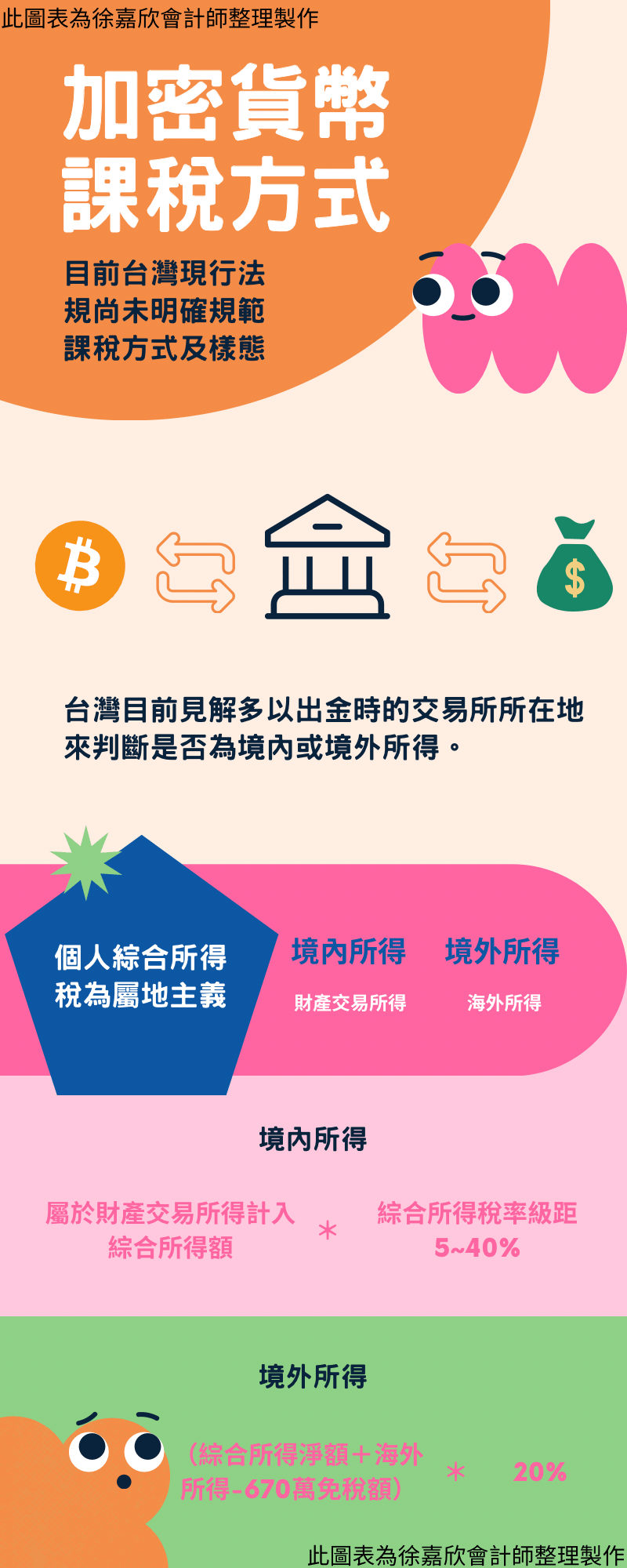
In other words, for domestic assets, comprehensive income tax is calculated as property transaction income — using the amount deposited into a platform like MAX as the cost, and the amount withdrawn as the income, with the difference calculated as gain, subject to the applicable tax bracket.
(For example: if you deposited NT$500,000 and withdrew NT$2,000,000, the resulting gain of NT$1,500,000 is included in your comprehensive income. Conversely, if you deposited NT$2,000,000 and withdrew NT$500,000, that's a NT$1,500,000 property transaction loss — if you have NT$500,000 of other property transaction income that year, you can offset up to that NT$500,000, not the full NT$1,500,000. If there's no property transaction income that year, or it's insufficient, the loss can be carried forward for 3 years.)
If you convert back to USD through Binance and it lands in a foreign currency account, it's generally treated as offshore income.
Again, income equals proceeds minus cost, but offshore income under NT$1,000,000 doesn't need to be included in basic income at all — meaning it's effectively tax-free below that threshold.
If offshore income exceeds NT$1,000,000, it needs to be included in basic income. Here are some examples:
Example 1: Net comprehensive income of NT$500,000, offshore income of NT$2,000,000, totaling NT$2,500,000 — below the NT$6.7 million exemption threshold, so the offshore income portion is effectively tax-free.
(500,000 + 2,000,000 − 6,700,000) < 0
Example 2: Net comprehensive income of NT$5,000,000, offshore income of NT$2,000,000, totaling NT$7,000,000 — the amount exceeding the NT$300,000... [exemption threshold] is subject to basic tax at 20% = NT$60,000.
However, if the regular tax calculated on the original net comprehensive income is greater than the basic tax, you simply pay the regular tax.
Here's the calculation:
- Basic tax: (5,000,000 + 2,000,000 − 6,700,000) × 20% = 60,000
- Regular tax: 5,000,000 × 40% = 2,000,000
Since 2,000,000 > 60,000, you'd pay tax based on the NT$5,000,000 regular calculation.
Example 3: Net comprehensive income of NT$500,000, offshore income of NT$6,500,000, totaling NT$7,000,000 — the amount exceeding the exemption threshold is subject to basic tax at 20% = NT$60,000.
However, if the regular tax calculated on the original net comprehensive income is less than the basic tax, you must pay the difference separately.
Here's the calculation:
- Basic tax: (500,000 + 6,500,000 − 6,700,000) × 20% = 60,000
- Regular tax: 500,000 × 5% = 25,000
Since 25,000 < 60,000, you would need to pay an additional NT$35,000 (60,000 − 25,000).
Filing honestly not only avoids doubts about the source of your funds, but can also serve as proof of financial capacity — making things like a future bank mortgage application easier, since the bank will trust your finances more readily.
There's also the matter of converting crypto back to fiat potentially falling under "business tax" — drawing a parallel from Taiwan's practice around auditing game currency.
If crypto is treated as a form of digital asset being bought and sold, under tax law, once the sales amount exceeds NT$40,000, business tax registration would be required.
But whether "domestic vs. offshore" is determined purely by the location of the exchange is, in my view, still an area where the regulations aren't fully settled and merits further discussion.
We recommend investors keep thorough records of their deposit/withdrawal history and cash flow, so that if needed, they have external documentation to explain their situation to the tax authority in the future.
We also recommend that before moving large sums of money, investors seek guidance from a CPA or other professional to properly handle tax filing — or, alternatively, just HODL until the bull market returns!
Have questions about this article or your company's situation? Feel free to get in touch.
Book a Consultation