Checklist for Online Sellers!
12/6/2022
With less than a month left in the year, the new tax registration rules take effect starting next year (2023) — here's the checklist for online sellers!
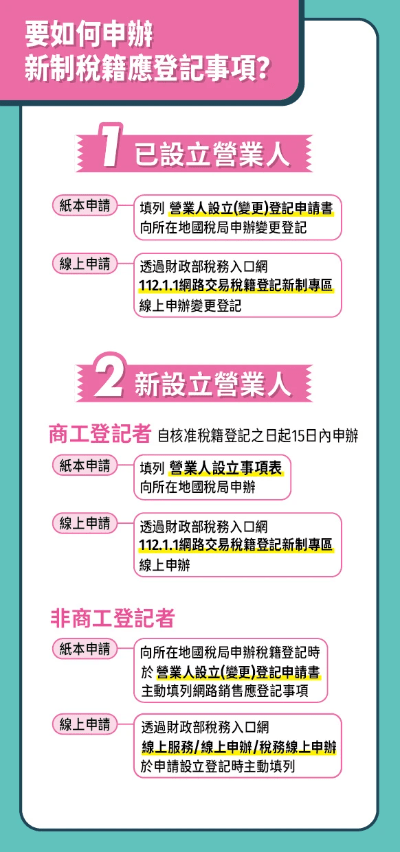
(Image reposted from the Ministry of Finance)
Under the Tax Registration Rules issued on August 8, 2022, starting January 1, 2023, businesses must additionally register their website domain and URL if they sell goods or services online or through other electronic means, or their member account if they sell through an online platform.
Businesses must also display their registered business name and unified business number on their sales platform.
In other words, businesses already established before 2023 need to apply to the National Taxation Bureau after January 1, 2023 to update their registration, adding their official website URL and member account information for platforms like Shopee or Pinkoi.
(To give businesses time to update their registration, there's a grace period from January 1 to April 30, 2023 — completing the update during this window avoids any penalty. Failing to update by May 1, 2023 will result in a fine.)
For businesses established after January 1, 2023, there's no grace period — if they already conduct online sales at the time of tax registration, they must include the relevant information, or risk violating tax law.
So what about sellers already selling online but who haven't registered a business yet?
First, check whether your monthly sales have reached the threshold requiring registration (NT$80,000 for goods, NT$40,000 for services). If you've reached it, register right away. If you're still below the threshold, you can temporarily hold off on tax registration, and you don't need to display your business name or unified business number on the platform either.
Some sellers worry: will registering now cause the tax authority to retroactively audit and demand back taxes on sales made before registration?
This comes back to the underlying rule: had your sales already reached the threshold requiring registration before you registered?
If you do get audited and owe back taxes, it's generally because you should have registered (or should have been issuing invoices) but weren't — not because registering triggered the audit.
Whether you sell through Facebook, Line, Instagram, or platforms like Shopee, the tax authority can easily obtain lists of sellers who should be registered, or whose monthly sales exceed NT$200,000 and should be issuing invoices, through transaction data shared by e-commerce platforms and payment service providers.
What's more, the tax authority can also obtain lists of so-called "high-frequency transaction" accounts through banks, to further identify potential audit targets.
(High-frequency transaction: refers to a single individual's single bank account with cumulative deposits/transfers/remittances totaling NT$2.4 million or more within a calendar year (Jan 1–Dec 31), with any 4 months in that year having 200 or more such transactions.)
So if you've already reached the registration threshold, we recommend registering promptly to avoid being caught later through an audit or report, resulting in back taxes and fines.
(Getting caught usually means back taxes plus fines — basically handing back everything you've earned so far. Definitely worth thinking carefully about!)
Along with this new rule taking effect, also watch out for potential scams.
Sellers' tax registration information could also be misused — both sellers and consumers should stay alert to avoid financial loss.
If you need help with tax matters or tax registration, feel free to add us on LINE.
Have questions about this article or your company's situation? Feel free to get in touch.
Book a Consultation