
A Look at Accounting and Tax in the Solar Power Industry
6/4/2021
Last month, Taiwan experienced two major blackouts within a single week, putting energy issues back in the spotlight.
In response to global climate change and rising environmental awareness, the government has been actively promoting renewable energy development in recent years, aiming to strike a balance between economic development and environmentally friendly power use through methods more friendly to the planet.
Renewable energy mainly falls into categories like solar, wind, hydro, geothermal, and biomass, with solar being the most widely known — and, aligned with Taiwan's energy policy, the category with the most companies invested in it.
Here's a rough sketch of the solar power industry value chain:
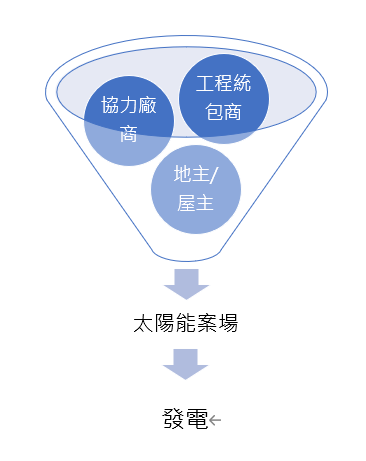
Common solar power operators are generally split into two types based on their revenue model: EPC (engineering, procurement, and construction) contractors, whose main business is construction, or energy service providers, whose main business is selling power (regardless of whether panels are installed on covered sports courts, in solar-aquaculture co-existence setups, or other configurations — anyone selling power generated by their own solar equipment qualifies as an energy service provider).
The two business models differ as follows:
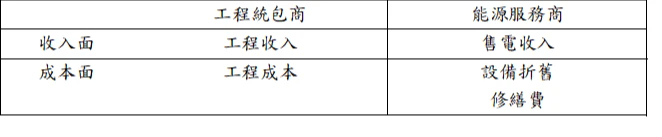
EPC Contractors: Percentage-of-Completion vs. Cost-Recovery Method
EPC contractors mainly provide turnkey construction services for solar projects, and don't hold ownership of the solar equipment after construction — making their revenue/cost recognition relatively straightforward. Profit/loss is generally calculated based on the contract duration (whether it exceeds one year), using either the percentage-of-completion method or the cost-recovery method.
In principle, for contracts lasting "one year or more," the percentage-of-completion method should be used. But the cost-recovery method may be used if the following circumstances make the contract's profit/loss genuinely impossible to estimate:
- The contract revenue receivable for each period cannot be estimated.
- Neither the costs required to fulfill the contract nor the percentage of completion at period-end can be estimated.
- Costs attributable to the contract cannot be identified.
(See Article 24 of the Regulations Governing the Assessment of Profit-Seeking Enterprise Income Tax for details.)
Energy Service Providers: Cost Recognition for Self-Constructed Assets
Energy service providers acquire solar equipment through self-construction, then sell the electricity generated by that equipment to Taipower or large power users.
The principle for determining the cost of self-constructed assets is similar to manufacturing — direct materials, labor, engineering costs, and so on that go into construction should all be attributed to the cost of the self-constructed asset. These costs cannot be recognized all at once in the year incurred; instead, once the asset reaches a usable condition, it's recognized as a fixed asset, with depreciation expense recorded over its useful life.
(See Statement of Financial Accounting Standards No. 8 and International Accounting Standard 16 for details.)
Sample journal entries:
1. Costs incurred during construction (e.g., solar modules, related engineering costs, and professional inspection fees)
- Debit: Construction in progress / Advance payments for equipment
- Credit: Accounts payable
2. When the asset reaches a usable condition
- Debit: Solar equipment
- Credit: Construction in progress / Advance payments for equipment
3. Recording depreciation expense (per the fixed asset useful life table, solar equipment has a 15-year useful life)
- Debit: Depreciation expense
- Credit: Accumulated depreciation — Solar equipment
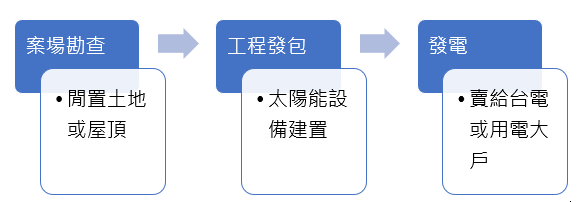
Before selling power, energy service providers generally go through a workflow like this:
Tax Considerations
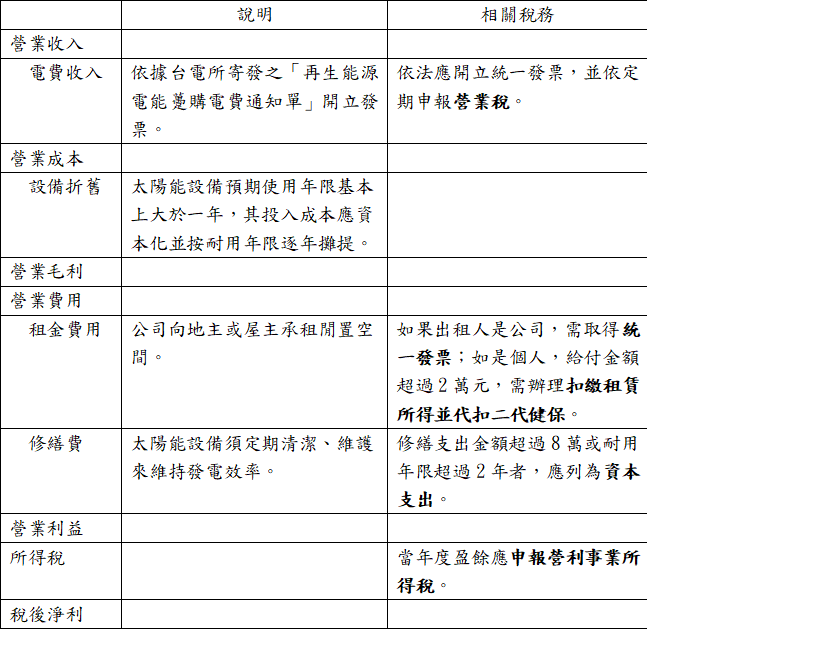
When operating an energy integration or power sales business, what tax matters should companies keep in mind? Here's a simple income statement to illustrate:
If you have any questions, feel free to discuss them with Chia Hsin!
Have questions about this article or your company's situation? Feel free to get in touch.
Book a Consultation