
Renovating Your Home? Get the Invoice — It Could Save You at Least 15% in Tax Later
9/29/2022
When you renovate your home and hire an interior designer, do you remember to ask for an invoice?
Since the House and Land Transactions Income Tax 2.0 rules took effect last year (2021), the tax rate on short-term property sales can go as high as 45% — meaning almost half of your sale proceeds could go to the government.
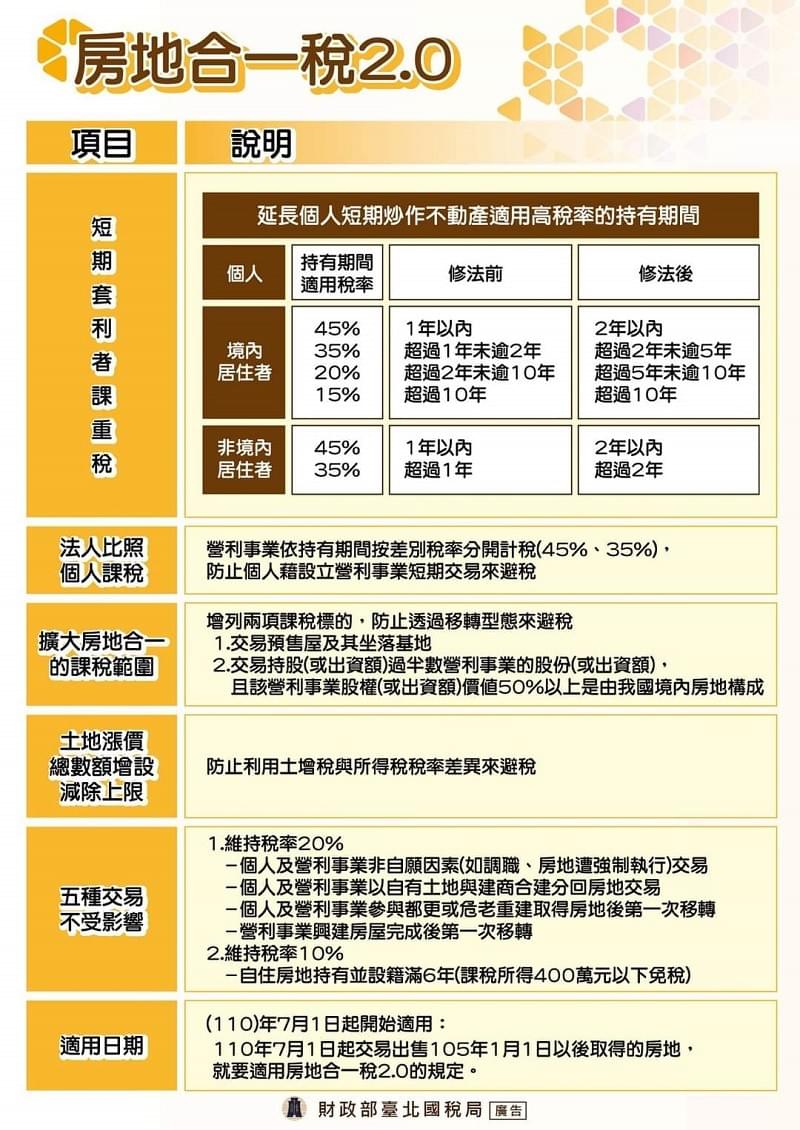
The intent was to cool down the overheated housing market driving up prices, so the rules also carved out 7 categories of "involuntary" property transactions.
The 7 involuntary personal property transaction scenarios:
- Job relocation or involuntary termination meeting statutory criteria.
- Boundary encroachment by another party.
- Compulsory execution under law.
- Major illness or accident requiring medical expenses.
- Fleeing a domestic violence perpetrator under a protection order.
- A co-owner selling the shared property without consent.
- Inability to repay a bank mortgage secured by inherited property.
But as they say, the ideal is full, reality is thin.
Real-life involuntary circumstances certainly aren't limited to these 7 — just look at item 1: how easy is it, really, to prove your termination was "involuntary" under the law?
Since we can't predict the future, let's at least make the most of what we can control now.
First, you need to understand how taxable income on a property transaction is calculated:
Taxable income = Sale price − Acquisition cost − Related expenses − Total land value increment
Both the acquisition cost when you bought the property and related expenses when you sell it can be legally deducted.
Today, we're focusing on the cost side.
If you bought the property, your acquisition cost is the purchase price, plus title transfer costs (deed tax, stamp duty, notary fees, registration fees, agent commission, etc.), and after acquiring the property, expenses that increase the property's value or functionality and are not consumed within 2 years — additions, improvements, or repairs.
The purchase cost and title-transfer fees are straightforward — even without keeping the original documentation, the tax authority can usually verify the transaction records from that time.
But what exactly counts as an expense that increases the property's value or functionality?
In plain terms, it's "renovation costs."
But renovation covers a huge range — patching a wall is renovation, and so is installing luxury imported furniture — leading many people to assume all "renovation costs" can be legally deducted.
In practice, tax authorities usually judge based on whether the expense is necessary for habitation, for example:
- Is plumbing/electrical work necessary for habitation? Yes — you can't live without water and electricity.
- Is masonry work necessary for habitation? Yes — repairing the roof, altering partitions, and so on.
But would you say you can't live without a TV, cabinets, curtains (and various home appliances)? Not necessarily, right?
So for this category of expense, the tax authority has discretion in deciding whether to include it in the cost calculation.
But none of this is really the crux of the matter — the tax authority makes the judgment, but what really matters to you is: did you get an invoice at the time?
In other words, do you have "legal" documentation proving you incurred these expenses?
A common situation for interior designers and renovation contractors is: to save the 5% business tax, clients ask them not to issue an invoice. Since ordinary individuals have no obligation to file business tax, everyone's fine with this at first — until it's time to sell the property, when, to reduce their tax burden, the same client turns around and asks the contractor to retroactively issue an invoice.
In principle, retroactively issuing an invoice is fine if the underlying transaction actually occurred — but the contractor may face the risk of being penalized for "failing to issue an invoice as required," and may not be willing to cooperate.
Worse still, if the contractor you hired never registered as a business in the first place, there's no way to retroactively issue an invoice at all — or if the renovation cost wasn't that high, or there was no actual renovation at all and it's just a fabricated invoice for tax evasion purposes, not only will the cost be disallowed, but the business that cooperated in issuing the invoice could also face penalties.
The bottom line, after all this: get the invoice — it's tax savings for your future self.
Pay 5% now (business tax), and save at least 15% later (the current House and Land Transactions Income Tax rate ranges from 15% to 45%).
If you have questions about renovation costs, House and Land Transactions Income Tax 2.0, or company setup, feel free to contact Chia Hsin — a dedicated staff member will be happy to explain.
Have questions about this article or your company's situation? Feel free to get in touch.
Book a Consultation