A Comprehensive Look at Type 1 and Type 3 Solar Power Plants
12/28/2023
Published in the December 28, 2023 issue (No. 297) of the Taiwan CPA Quarterly
Yi Ting Accounting Firm — Hsu Chia Hsin, CPA Yi Ting Electrical Engineering Consultants Co., Ltd. — Hsu Cheng Kang, Licensed Electrical Engineer
Introduction
Amid the global push toward net-zero emissions and Europe/US carbon border adjustment trends, net-zero transition is no longer just an environmental issue — it's an economic issue tied to every industry's international competitiveness. Apple recently announced progress on its global supply chain decarbonization plan, aiming for 100% renewable energy use in Apple-related manufacturing by 2030 — making renewable energy adoption an urgent need for Taiwanese suppliers hoping to join Apple's supply chain. This October (2023), the EU's Carbon Border Adjustment Mechanism (CBAM) entered its trial phase, hitting Taiwan's steel exporters first — and as CBAM's scope continues to expand, supply chains and SMEs alike will need to pay closer attention to energy efficiency and greenhouse gas emissions.
The Executive Yuan passed the "Circular Economy Promotion Program" on December 20, 2018, integrating circular economy principles and sustainable innovation into economic activity — one of its key initiatives being "promoting energy/resource integration and industrial symbiosis." Whether it's "biogas power generation at pig farms" or "solar-aquaculture co-existence" combined with fish farming, both aim to balance environmental protection and ecology to achieve sustainable economic development. Using renewable energy not only helps reduce greenhouse gas emissions, but also plays an important role in revitalizing local economies and improving the environment.
This article aims to introduce readers to common technical terms in the solar power field — "Type 1" and "Type 3" — along with the relevant regulatory framework. These terms are essential to understanding the development of the solar power industry and its regulatory context.
Defining Type 1 and Type 3 Plants
The names "Type 1" and "Type 3" solar plants come from the definitions in Article 3 of the Regulations Governing the Installation and Management of Renewable Energy Generation Equipment [3]: "Type 1 renewable energy generation equipment: generation equipment installed by a power generation business under the Electricity Act and related regulations. (...) Type 3 renewable energy generation equipment: self-use generation equipment using renewable energy with an installed capacity under 2,000 kW."
From the statutory text, we can infer that regardless of installed capacity, any renewable energy generation equipment applied for under the Electricity Act [4] is Type 1 renewable energy generation equipment ("Type 1"); other renewable energy generation equipment under 2,000 kW not established under the Electricity Act is Type 3 ("Type 3"). Generally speaking, Type 1 plants tend to be generation equipment of 2,000 kW or above (large plants), while equipment under 2,000 kW is generally installed as Type 3 (small plants).
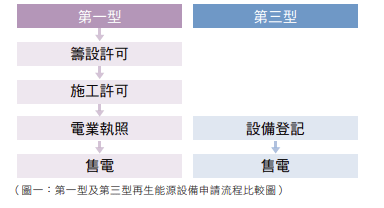
With the liberalization of Taiwan's electricity market, many green power models have emerged, including shared step-up stations, wheeling of green power, and self-generation/self-use. Type 1 electricity businesses, after going through the Ministry of Economic Affairs' establishment permit and construction permit process, obtain a power business license, after which they can grid-connect with Taipower depending on each project's circumstances, wheel power through Taipower's feeder lines to other entities needing green power certificates, or sign a power purchase agreement with Taipower. Type 3 electricity businesses, on the other hand, skip the MOEA's specially-licensed business review process, and can sign a power purchase agreement with Taipower after obtaining consent from the local competent authority (as shown in Figure 1).
Differences in Who You Can Sell Power To
Following the 2017 amendment to the Electricity Act, private production and sale of green power was opened up. Under Article 9, Paragraph 1 of the Regulations Governing the Installation and Management of Renewable Energy Generation Equipment, in principle, anyone installing solar power generation equipment should sign an agreement with Taipower, unless they meet the conditions under Paragraph 4 of the same article: "1. Direct supply or wheeling under the Electricity Act and related regulations. 2. Self-use with no electricity sold to the grid. 3. Selling electricity to a renewable energy retailer" — in which case they're exempt from signing an agreement with the public utility (as shown in Figure 2).
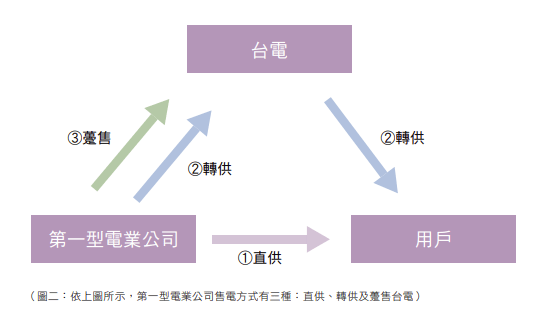
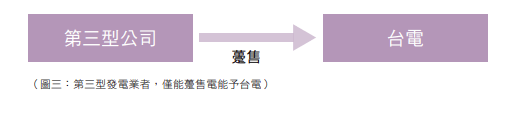
Therefore, whether large or small, any solar power business wishing to sell electricity to parties other than Taipower must apply as Type 1, obtain an establishment permit and construction permit from the Bureau of Energy, and then exchange these for a power business license before beginning to sell power — and must add or establish the business item "D101011 Power Generation Business." For Type 3, power can only be self-used or sold to Taipower, under the business item "D101060 Renewable Energy Self-Use Generation Equipment Business" — since this isn't a specially-licensed business item, solar power businesses simply need to apply to change their business registration with the competent authority before starting operations (as shown in Figure 3).
The Path for Small Plants to Transition
To promote renewable energy development, the government introduced a guaranteed renewable energy feed-in tariff purchase system — the system described above, under which solar power equipment operators generally sign an agreement with Taipower. The feed-in tariff currently varies by installed capacity and is announced annually by the Ministry of Economic Affairs as the "Renewable Energy Feed-in Tariff Rates."
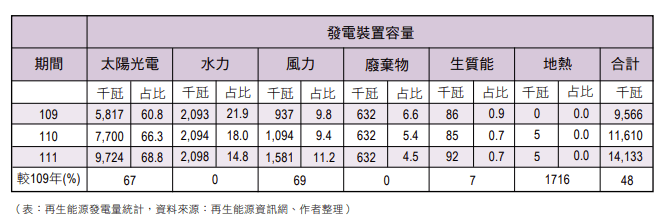
Looking at historical feed-in tariffs through the government's open data platform [6], we can see that as solar installed capacity grew from 636,000 kW in 2014 to a total of 9,724,000 kW in 2022 — a 15-fold increase — the feed-in tariff for rooftop generation equipment with installed capacity between 10 and 100 kW dropped from an average of NT$6.419/kWh in 2014 to NT$4.47/kWh in 2023.
As installed capacity continues to rise, the feed-in tariff is bound to keep declining year over year. If a small plant converts to Type 1, it can not only supply Taipower, but also directly supply or resell to other green power buyers, or even sell power to renewable energy retailers. This lets small plants participate more actively in green power trading, with more flexibility to adapt to a constantly changing energy market. In such a supply-demand imbalanced market, small plants have the opportunity to seek out more trading opportunities and favorable terms.
Given supply chain and policy pressure, urgent demand in Taiwan's green power market, and the shrinking incentive from the feed-in tariff, ordinary business logic would suggest this should drive more Type 1 plants to join, or more Type 3-to-Type 1 conversions.
But according to updated data on privately-owned solar power generation business installed capacity released by the Bureau of Energy on October 19, 2023 [7], Type 1 installed capacity currently accounts for just 16% of Taiwan's total solar installed capacity — meaning the vast majority of solar capacity still hasn't entered the market.
Although under the current "Renewable Energy Generation System Power Purchase Agreement Template (2022 Regulations Revision)" [8], either party may terminate the agreement by mutual written consent at any time before the contract term expires, most small plants still choose to maintain their power purchase agreement with Taipower.
While pursuing green power trading liberalization, the application process required for Type 1 plants remains complex and lengthy.
At the land development stage, given Taiwan's limited land and dense population, considerable time is needed to find suitable land, and given the deeply held cultural view that land ownership equals wealth, most private landowners are unwilling to be locked into a 20-year lease term, making land development difficult. Furthermore, if the land falls within an environmentally protected zone, beyond communicating with local residents, consent from various relevant government agencies is also needed — and in practice, because responsibilities across agencies aren't always clearly delineated, the review process at each stage tends to be lengthy.
Solar panel construction is also affected by fluctuations in raw material costs [9], and as the overall solar industry faces cost inflation pressure, capital needs increase significantly. As solar plant installed capacity expands, construction and operation timelines also lengthen, making it harder to secure bank loans. Additionally, if a small plant's power buyer isn't Taipower, this may also affect the bank's assessment of repayment ability, creating additional challenges for the solar industry in securing financing.
Type 1 plants must also comply with strict regulatory standards throughout the application process, which is clearly a heavy burden for small plants to bear. Regulatory requirements span technical, operational, and environmental standards — under Article 66 of the Electricity Act, "To ensure information disclosure, an electricity business shall compile a concise monthly report on its business status, power supply and demand, and financial status, and shall compile an annual report within three months after the end of each fiscal year, to be submitted to the electricity regulatory authority and the central competent authority for reference, with relevant information disclosed to the public." For smaller-scale plants, this not only adds compliance complexity but also requires more resources to meet these standards — likely one of the obstacles to small plant conversion, leading to a situation where, despite strong incentives in the free trading market, operators remain hesitant to commit.
Conclusion
Whether Type 1 or Type 3, solar power plays an indispensable role in Taiwan's renewable energy generation. To achieve energy transition goals, if future regulations can be adjusted in response to market changes, or if responsibilities across government agencies can be more clearly delineated to shorten administrative timelines, this would likely boost solar power operators' willingness to establish Type 1 plants, further promoting renewable energy development. This would help Taiwan achieve a more sustainable and environmentally friendly energy future, while also promoting growth in the green energy industry, bringing positive impact to both the economy and the environment. We look forward to more regulations and policies that will drive renewable energy development and help Taiwan maintain its leading position in the green energy field.
References
- Renewable Energy Generation Statistics, August 2023 Monthly Report, Renewable Energy Information Network.
- Historical Renewable Energy Installed Capacity, Taiwan Power Company.
- Regulations Governing the Installation and Management of Renewable Energy Generation Equipment, Ministry of Economic Affairs, May 19, 2022.
- Electricity Act, Ministry of Economic Affairs, June 28, 2023.
- Renewable Energy Feed-in Tariff Rates, Bureau of Energy, Ministry of Economic Affairs, January 6, 2023.
- Renewable Energy Feed-in Tariff Rates and Calculation Formula, Government Open Data Platform, October 4, 2023.
- Privately-Owned Solar Power Generation Business Installed Capacity Data, Bureau of Energy, Ministry of Economic Affairs, October 19, 2023.
- Renewable Energy Generation System Power Purchase Agreement Template (2022 Regulations Revision), Taiwan Power Company.
- Industry Value Chain Information Platform.
Have questions about this article or your company's situation? Feel free to get in touch.
Book a Consultation